Aluminium Formwork System: How It Improves Construction Speed, Precision and Cost Efficiency
The construction industry is constantly looking for better ways to build faster, improve structural quality, reduce material waste, and maintain consistency across large-scale projects. Traditional formwork methods can create challenges such as longer construction cycles, high labour dependency, material wastage, and inconsistent concrete finishes.
Aluminium formwork systems offer a modern solution to these challenges. Designed for repetitive construction, monolithic casting, and high dimensional accuracy, aluminium formwork can help developers and contractors create a more predictable and efficient construction process.
What Is an Aluminium Formwork System?
An aluminium formwork system is a modular construction system used to create the mould into which concrete is poured. Unlike conventional timber-based formwork, aluminium panels are precision-engineered and designed for repeated use.
The system can be configured for multiple structural elements, including:
Walls
Columns
Beams
Slabs
Staircases
Deck structures
Because the panels are manufactured according to project-specific structural and architectural requirements, the same system can support highly repetitive construction across multiple floors.
For high-rise residential, commercial, and infrastructure projects, this repeatability can become an important factor in maintaining construction schedules.
Why Is Aluminium Formwork Becoming Important in Modern Construction?
Large construction projects need more than just strong materials. They require speed, accuracy, coordination, and predictable execution.
Aluminium formwork addresses several of these requirements through a modular system that allows structural elements to be assembled, aligned, cast, and removed in a planned sequence.
A well-designed system can help construction teams achieve:
1. Faster Construction Cycles
One of the biggest advantages of aluminium formwork is its ability to support repetitive floor construction.
Walls, slabs, beams, and columns can be prepared for simultaneous or coordinated concrete casting. This creates a more streamlined workflow compared with construction methods that require multiple independent formwork processes.
Qore Formwork’s site protocol is designed around high-velocity construction workflows and standard 4-to-5-day monolithic floor slab casting cycles, subject to project conditions and execution.
For developers working on large residential towers or other repetitive structures, reducing the floor cycle can have a significant impact on the overall project timeline.
2. Improved Dimensional Accuracy
Precision is critical when constructing reinforced concrete structures.
Poorly aligned formwork can result in variations in wall dimensions, slab levels, openings, and concrete geometry. These issues may subsequently require additional correction work.
Precision-manufactured aluminium panels are designed to maintain consistent geometry from one casting cycle to another.
Qore’s manufacturing process includes dimensional inspection, panel leveling, precision cutting and punching, and final system auditing to maintain the required panel specifications.
This focus on accuracy can contribute to cleaner concrete surfaces and reduce the amount of corrective finishing required after de-shuttering.
3. Monolithic Concrete Construction
Aluminium formwork is particularly useful for monolithic construction.
In a monolithic pour, structural components such as walls and slabs can be cast together according to the engineered construction sequence. This creates a more integrated structural system and helps reduce the number of separate casting operations.
For repetitive buildings, this approach can improve site coordination between:
Reinforcement teams
Formwork teams
MEP teams
Concrete teams
Quality-control teams
Better coordination can ultimately make the construction cycle more predictable.
4. High Reusability
Unlike disposable or short-life formwork materials, aluminium panels are designed for repeated casting cycles.
Qore Formwork specifies its system for 200+ reuse cycles with proper site handling and maintenance.
High reusability can make aluminium formwork particularly suitable for projects containing a large number of similar floors or structural units.
Instead of purchasing new formwork for every casting operation, the same panel inventory can be reused throughout the project.
The actual number of cycles, however, depends on factors such as handling, cleaning, storage, maintenance, site practices, and project conditions.
5. Reduced Dependence on Timber
Traditional timber formwork can generate significant material waste, particularly on projects involving repetitive construction.
Aluminium offers an alternative because the panels are designed for repeated use and can be maintained, refurbished, and reused.
Qore also describes a circular manufacturing approach in which existing formwork components can be recovered, reprocessed, and re-engineered for future applications.
This approach can support a more resource-efficient construction lifecycle.
6. Lightweight and Crane-Free Handling
Modern aluminium formwork systems are engineered to balance strength with manageable weight.
Qore’s system specifications indicate a system weight of approximately 21–24 kg/m², with lightweight elements designed for manual handling.
Reducing dependence on cranes for routine panel movement can provide greater flexibility on construction sites, particularly where multiple activities are taking place simultaneously.
However, the appropriate handling method should always be determined by the project’s engineering, safety, and site requirements.
7. Better Concrete Surface Finish
Another important advantage of precision formwork is the potential for a more consistent concrete finish.
Accurate panel alignment and properly maintained form faces can produce smoother concrete surfaces, potentially reducing the amount of plastering and corrective finishing required.
This is particularly valuable in projects where construction speed and finishing quality are both important.
Understanding the Material: Grade 6061-T6 Aluminium
The performance of an aluminium formwork system depends heavily on the material and manufacturing quality.
Qore Formwork specifies Grade 6061-T6 aluminium alloy for its formwork components. The alloy is selected for its strength-to-weight characteristics, dimensional performance, and suitability for repeated use.
However, material selection is only one part of the equation.
The overall performance of a formwork system also depends on:
Engineering design
Welding quality
Dimensional tolerances
Panel alignment
Surface treatment
Cleaning and maintenance
Installation practices
Site supervision
A high-quality alloy combined with accurate manufacturing and proper site handling can provide a more reliable formwork lifecycle.
How Aluminium Formwork Is Manufactured
Precision manufacturing plays an important role in the performance of an aluminium formwork system.
A typical manufacturing process may include several stages.
Material Inspection
The aluminium alloy is inspected to verify its required material characteristics before manufacturing begins.
Precision Cutting and Punching
Profiles are cut according to engineering requirements, while accurately positioned holes support the connection of panels, pins, wedges, and other accessories.
MIG Welding
Structural joints are welded to create durable connections capable of handling the pressures generated during concrete placement.
Grinding and Smoothing
Welded areas are cleaned and finished to achieve a smoother panel surface.
Dimensional Inspection
Panels are checked for dimensional accuracy, including length, width, geometry, and diagonal symmetry.
Leveling and Adjustment
Panels are checked and adjusted to minimize distortion and maintain accurate wall and slab geometry.
Protective Coating
A protective surface treatment can help improve durability and simplify de-shuttering and maintenance.
Barcode and Asset Tracking
Individual panels can be tagged and tracked throughout their lifecycle, making inventory management and refurbishment easier.
Final Quality Audit
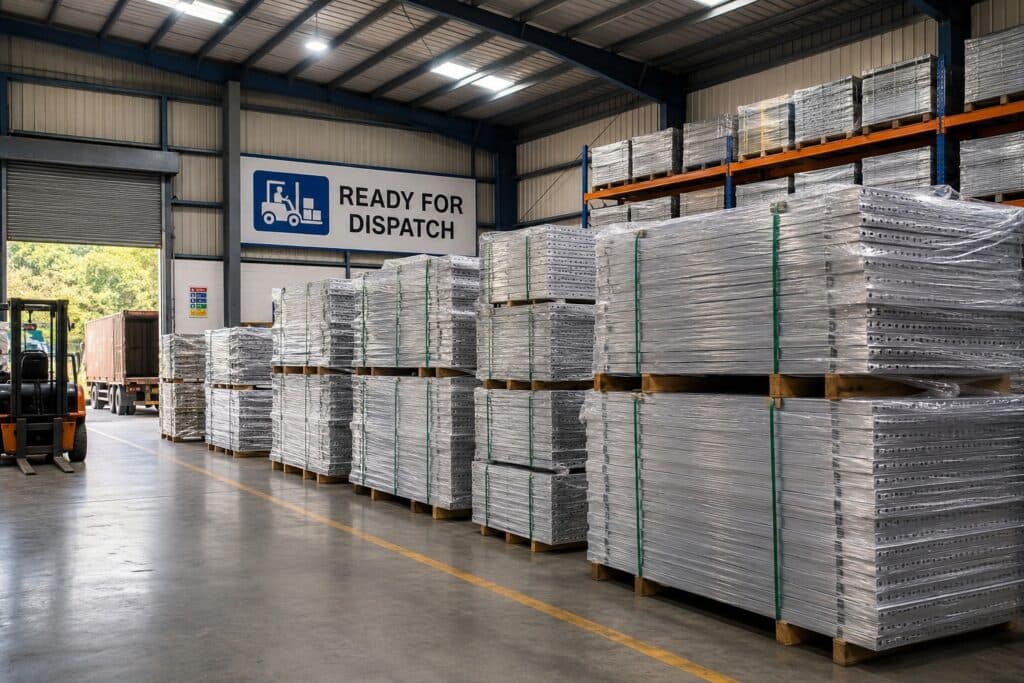
The completed system is checked against the specified engineering requirements before dispatch.
Qore describes a 10-step manufacturing quality protocol covering these stages from material inspection through secure packaging and dispatch.
Aluminium Formwork vs Traditional Formwork
The right formwork system depends on project requirements, but aluminium formwork offers several advantages for repetitive construction.
| Feature | Aluminium Formwork | Conventional Timber-Based Formwork |
|---|---|---|
| Reusability | High | Generally lower |
| Dimensional consistency | High when precision manufactured | Depends heavily on site workmanship |
| Construction speed | Suitable for repetitive fast-cycle projects | Can require more individual operations |
| Weight | Relatively lightweight | Varies by system |
| Material waste | Lower potential with repeated reuse | Can be higher |
| Surface finish | Consistent with proper alignment and maintenance | Depends on material and workmanship |
| Best suited for | Repetitive structures and high-rise construction | Projects with varying or non-repetitive requirements |
The comparison should always be made according to the project’s design, budget, construction sequence, labour availability, and required repetition.
When Should You Consider Aluminium Formwork?
Aluminium formwork can be particularly suitable when a project has:
A high number of repetitive floors
Standardized room or unit layouts
Tight construction schedules
Large-scale residential development
High-rise construction
A requirement for consistent dimensions
A need for repeated formwork cycles
A focus on reducing material waste
For a highly customized structure with little repetition, another formwork solution may sometimes be more appropriate.
The key is to select the system during the planning stage rather than treating formwork as a last-minute site requirement.
The Importance of Formwork Engineering and Site Planning
Buying aluminium panels alone does not guarantee faster construction.
The system needs to be engineered around the project’s structural and architectural drawings. Panel layouts, construction sequences, reinforcement, MEP coordination, stripping procedures, storage, and subsequent floor cycles all need to work together.
This is why an integrated formwork provider can be valuable.
Qore Formwork describes its service as an end-to-end process covering engineering, manufacturing, project planning, technical support, refurbishment, and re-engineering.
This integrated approach can help developers and contractors manage the complete lifecycle of their formwork assets.
Why Refurbishment and Re-Engineering Matter
Formwork does not necessarily become unusable after one project.
With proper inspection, cleaning, repair, leveling, and refurbishment, aluminium panels can potentially be prepared for another project.
Qore provides refurbishment and re-service capabilities that include restoration, cleaning, leveling, and upgrading of used aluminium formwork panels. It also offers re-engineering to adapt existing inventory to different project layouts.
This can improve asset utilization and reduce the need to manufacture an entirely new system for every project.
The Future of Construction Is More Predictable
Modern construction is moving toward systems that provide greater predictability.
Developers want faster floor cycles. Contractors need easier site coordination. Engineers need dimensional consistency. Project owners want better control over time, quality, and material utilization.
Aluminium formwork brings these requirements together through a combination of:
Precision + Reusability + Speed + Modular Engineering + Site Coordination
When properly engineered and executed, the system can transform formwork from a temporary site activity into a structured production process.
Conclusion
Aluminium formwork is becoming an important construction technology for projects where speed, repetition, precision, and efficient material utilization are priorities.
From monolithic concrete casting and high reusability to precision manufacturing and integrated project support, a well-engineered aluminium formwork system can help construction teams establish a more consistent building process.
For developers planning large-scale residential, commercial, or infrastructure projects, evaluating aluminium formwork during the design and planning stage can help identify opportunities to improve construction efficiency and project predictability.
Qore Formwork focuses on precision-engineered aluminium formwork solutions, manufacturing, re-engineering, refurbishment, project coordination, and technical support for modern construction requirements.
If your next project involves repetitive floor construction, high-rise development, or a demanding construction schedule, aluminium formwork may be worth evaluating as part of your overall construction strategy.
Frequently Asked Questions
1. What is aluminium formwork?
Aluminium formwork is a reusable modular formwork system used to cast concrete walls, slabs, beams, columns, and other structural components with high dimensional consistency.
2. How many times can aluminium formwork be reused?
The number of reuse cycles depends on design, manufacturing quality, handling, cleaning, maintenance, and site conditions. Qore specifies its system for 200+ cycles with proper handling and maintenance.
3. Is aluminium formwork suitable for high-rise buildings?
Yes. Its repeatable modular design makes it particularly useful for high-rise and large-scale projects with repetitive floor layouts.
4. Does aluminium formwork reduce construction time?
It can help reduce construction time by enabling coordinated and repetitive casting cycles. Actual cycle times depend on project design, manpower, engineering, logistics, and site execution.
5. Is aluminium formwork better than timber formwork?
Neither system is universally better. Aluminium formwork can have significant advantages for repetitive construction because of its reusability, dimensional consistency, and suitability for fast-cycle construction.
6. Can used aluminium formwork be reused for another project?
Yes, depending on its condition and compatibility with the new project. Refurbishment and re-engineering can help extend the useful life of existing formwork inventory.
SEO Title
Aluminium Formwork System: Benefits, Applications & Construction Efficiency
Meta Description
Discover how aluminium formwork systems improve construction speed, precision, reusability and efficiency for high-rise and large-scale building projects.
Suggested URL Slug
aluminium-formwork-system-construction-benefits
Primary Keyword
Aluminium Formwork System
Secondary Keywords
Aluminium Formwork
Aluminium Formwork System in India
Aluminium Formwork Manufacturer
Aluminium Formwork for High Rise Buildings
Aluminium Formwork Construction
Monolithic Formwork System
Aluminium Formwork Benefits
Aluminium Formwork Company
Reusable Aluminium Formwork
High Rise Construction Formwork